EGREGORE (2024)
LEAD NARRATIVE/QUEST DESIGNER
PLATFORM: Unreal Engine - PC
GAME DEVS OF COLOR 2024 OFFICIAL SELECTION
Led a 4-person team in creating a branching, nonlinear mystery narrative focused on player expression and information flow.
Using an ability to shift reality based on connecting information together, you find yourself pulled into an occult conspiracy in Cairo surrounding the summoning of a mysterious being called an “Egregore.”
-
USC Games MFA Thesis/Advanced Games Project
A classic-style adventure game where information can be linked via node-based graphs to manipulate conversations, objects, and locations
-
Outlined and finalized the narrative for all 3 major levels of the game
Tutorial: A Cardboard Box where players are called to Cairo
Cafe Ramses: A Historical Cafe/Restaurant where players can change large portions of the location to collect information to make progress
Sanctum: A surreal shopping-mall-turned-cult-hideout where the rules established are taken away and players are forced to adapt to the rules of the cult
Established unique dialogue for 50+ node combinatorics with 3 unique questlines available at any time to players
Standard example: Asking characters about each other for extra flavor
Edge Case “reward” example: Moving a bookshelf to the most magical part of the bar and having it spring to life to give extra hints or flavor to players
Implemented and iterated on quest design logic using Unreal Blueprints.
Generated documentation for the entire team, including style guides, story beats, narrative outlines, and character sheet
I reminded teammates that we were focusing on culture and history and kept reference books in our workspace
Writers were instructed to run towards weird/surreal moments instead of shying away from embracing unconventional ideas
-
Updated narrative in-game weekly based on team and playtest feedback
Conducted weekly narrative meetings alongside other Narrative Designers and the Director
Attended VO Sessions to assist VO Director and give additional narrative context to dialogue
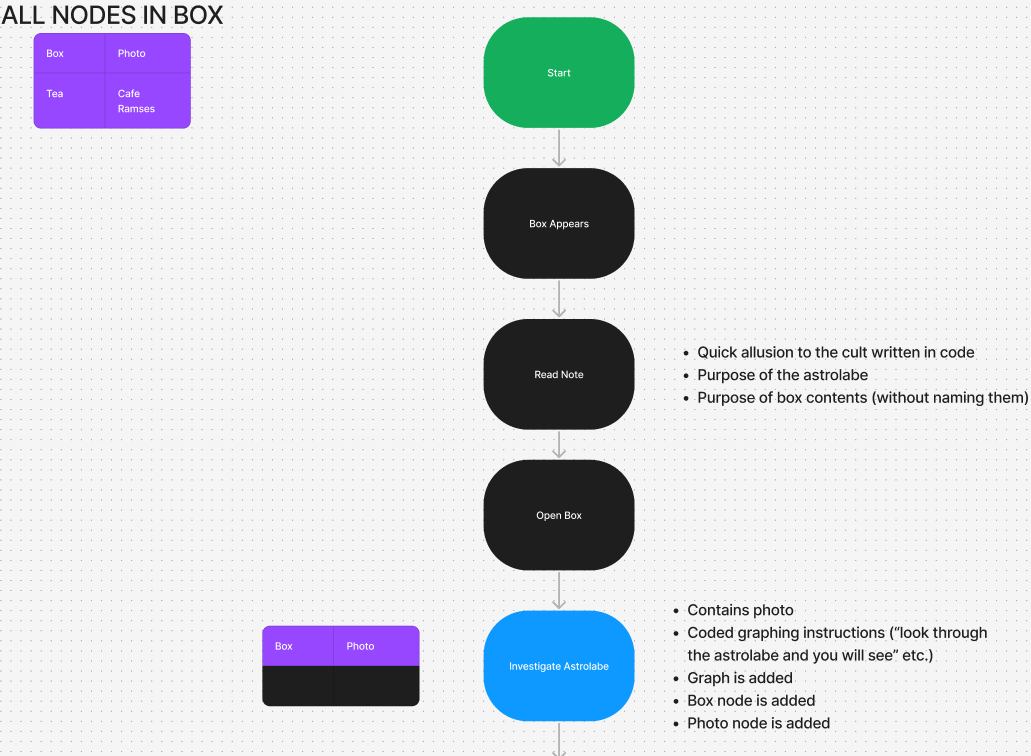
1/3: Flowchart of the tutorial level, a box with several props. By connecting these props together via the Astrolabe, their relationships are made clear and the path to Cafe Ramses opens. Mind-map tile legend: Purple: Object/Person | Green: Location | Yellow: Concept/Idea All nodes are in the same mind map. Color indicates subcategory, which determines how a node behaves as the player makes more connections.
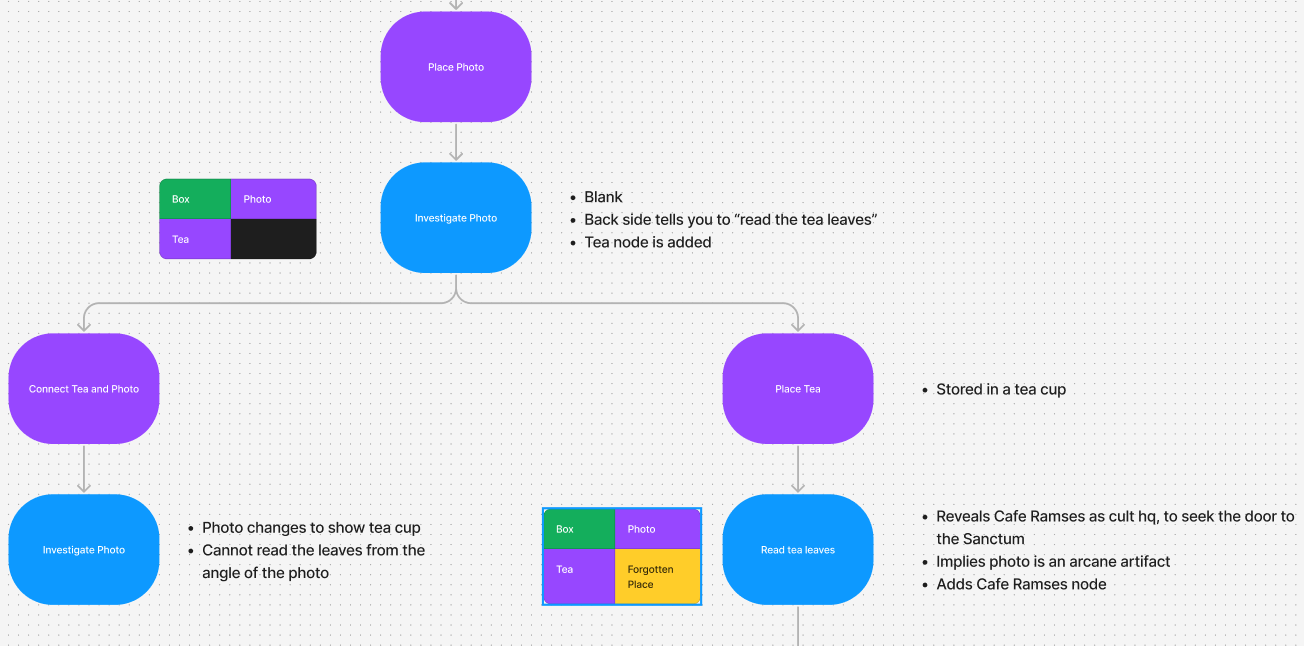
2/3: Optional branches that give deeper context to the game's world.
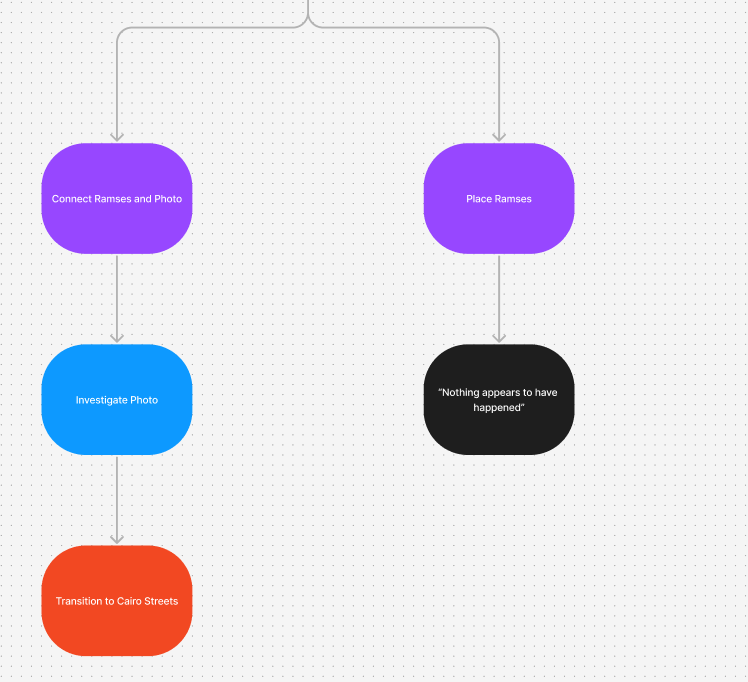
3/3: The tutorial’s final gate. One side is a fail state that prompts players to revisit the mind map, and the other is how to progress further into the story.

An example of Graph Combo documentation mid-production. Green is in-engine, Orange is under review, Purple means it requires editing/rewriting, and Red is still being drafted. Certain segments move character locations and unlock entire conversations, while others highlight relationships between characters, locations, and objects. Each character has their own quest line, which if followed through gives players access to the Sanctum Finale sequence.

The dialogue graph for the first interaction with the character Al-Bawab (Arabic for Gatekeeper/Doorman). Each line between nodes is a state check that unlocks a given dialogue option only when its condition is met. The option shown in-game (right) unlocks entry to Cafe Ramses after the player connects "Al-Bawab" and "Magic Door."

An example of in-game dialogue. The top option allows entrance into Cafe Ramses and is only made available by connecting "Al-Bawab" and "Magic Door" in the player's mind map via gameplay.
TRY AGAIN (2023)
LEAD NARRATIVE DESIGNER
PLATFORM: Unity- PC
Led a team of 3 in developing a character-driven, dialogue-heavy story that prioritized clarity alongside high-intensity platforming gameplay.
IGF 2024 “Best Student Game” Finalist
-
An action platformer developed for the USC Games Advanced Game Project.
A dark satire of the “plight of the solo dev,” players uncover the story of a game designer struggling with masterpiece syndrome
-
I wrote, edited, and finalized all scripted dialogue in screenplay format
I created over 50 lines of barks that could be played in between scripted dialogue
Outside of what was seen in-game, I created casting sheets, character backstory, and additional documentation as was required by production
I attended VO sessions, giving feedback and direction to our voice actors during sessions
In-engine, I worked to add subtitles that matched the pace of VO as each line played during gameplay
-
Led narrative team of 3 in finalizing general narrative of game, including cutscenes and scripted gameplay lines
Conducted weekly team meetings alongside director and producers
Assigned tasks for all sprints and answered questions from teammates regarding narrative
Communicated game/level design and audio teams to ensure each discipline was aware of any and all narrative updates
Tested the build with project leads, ensuring 90+ lines of dialogue in 15-minute experience were properly paced with gameplay
Help a temp asset escape an unfinished game while avoiding the clutches of the game’s designer.
TRY AGAIN FINAL BARK SHEET

The finalized barks from TRY AGAIN’s production. To make the game feel more kinetic and lived in, we worked with the design team to keep track of several variables as indicated in the Action tab.
The complete screenplay written for TRY AGAIN.
-
![]()
Early Narrative Meeting Notes
-
![]()
Revision of Game's Core Themes
-
![]()
Revisiting Builds for Timing/Rewrites
-
![]()
VO Casting Sheet for Benny
-
![]()
VO Casting Sheet for The Designer


CURTAIN CALL (2022)
NARRATIVE DESIGNER
PLATFORMS: Unity - PC/Mac
NEW MEDIA WRITING PRIZE 2022 SHORTLIST
MELBOURNE QUEER GAMES FESTIVAL 2022 SHORTLIST
Wrote and implemented 2 long-form Date and 3 short-form Conversation scenarios focusing on branching narrative, replay value, and high-impact character moments.
-
Billie’s final date
Jodie’s 3rd date
Billie’s TTRPG Conversation
Jodie’s Music Conversation
Jodie’s Breakup Conversation
-
I drafted and implemented 2 long-form “Date” and 3 short-form “Conversation” scenarios for players
Dates last 10-20 Minutes with several branches that reward subsequent playthroughs
Conversations last maximum 5 minutes and exist to deepen player’s relationship with the cast outside of a date scenario
My dates frequently had upwards of 40 different branching character responses per scenario
My paradigm was all about agency and excitement, so choices could completely reshape the outcome of a date
An example shown above is in Jodie’s date, where players could choose where to explore in the aquarium which alters the topic of conversation. This invites even more branches for player expression and exploration
-
Start by deciding on a character + location
Simple outline in a word processor emphasizing character moments + narrative beats
Rough draft in Yarn Spinner
Iterated based on feedback from teammates and playtests
Final Draft Implemented in Unity
Our goals while designing each scenario were to make the characters feel real and have players feel like their choices have value beyond just numeric outputs.
Help three college students survive young adult life in a visual novel inspired by Jungian psychology and real-life experiences.

Rough draft for Jodie's 3rd date. As a basic outline, it just showcases each major option throughout the sequence before drafting in Yarn Spinner for more extended content generation.

Yarn Spinner excerpt from Billie's final date. Everything in pink is Markup text that controls game functions during runtime or switches to the next node. Everything in black is text that is presented to the player by making choices during gameplay.

Both of these dialogue choices link to either more dialogue or a new node in Yarn Spinner.
A greybox playground to test player movement, level design, and controls.
DESIGN INTENT: A space to map out distance thresholds for jumps and text-based narrative prompts.
After finding a mysterious cassette player, two teenage girls in a small Michigan town discover an alternate world that lets them finally be themselves— but a sinister entity lies in wait, ready to use them as a way to break out into the real world.
UNSPOOLED (WIP)
SOLO DEVELOPER
PLATFORM: Unity - PC
-
A horror-themed action platformer inspired by Alice: Madness Returns, I Saw the TV Glow, and modern liminal horror.
Currently in development
-
Created greybox playground and tutorial levels to test player flow, movement mechanics, and story progression
Developed a rudimentary player controller including ledge detection, climbing, short hops, and third person aiming
-
Writing entire game narrative in 3 act structure, from when the protagonists find the cassette player to when the entity breaks out in the final encounter.
Created several moodboards to capture specific visual ideas, level design ideas, and draw stylistic inspiration

Moodboard for Buckthorn, the girls' hometown. The visuals carry an emphasis on loneliness, isolation, and cool tones to build an oppressive yet grounded atmosphere.

A section of the moodboard for the Cassette World, a surreal, twisted vision of Buckthorn. Colors are more vibrant, visuals are more explicitly surreal, and intense color choices create a familiar but disconcerting atmosphere.

A section of the moodboard for Charlie Seeming, the player character. Inspired by 90s horror icons like Buffy the Vampire Slayer alongside a cheery skate-punk style.

A section of the moodboard for monsters seen in the Cassette World. Designs focus on defamiliarization, corruption of the human form, and static disturbance physically affecting living beings when the tape in the cassette player distorts or skips.